Regardless of operation, PCBN-grade, workpiece material or stability of the setup, the most important thing to start with before developing an operation is to make sure that the conditions are the best possible. Conditions of tool holders are one of the things that are too often ignored at customers when there are tool life issues.
The tool holder below is one example what was found at a customer where they had problems with breakage of solid triangular inserts when clamping them. Just a quick look into the machine showed this holder which has severe damages probably due to a collision of some kind. The tool life problem was solved just by changing the tool holder to a new one. The whole matter was finished with an education of the machine operators regarding hard turning, PCBN inserts, how to use them and so on.
For more information, please contact your local Seco representative, or our Advanced material (PCBN/PCD/CERAMIC) team.
1 kommentarer
Turning of Aluminium Alloy component
23:24
The main alloying element in Aluminium alloys is Silicon, and the more Silicon is added, the more abrasive the material becomes. This means that the cutting speed has to be adjusted based on the Silicon content.
General recommendations for PCD are:
- Low Silicon (< 8%) Cutting speed 600 – 2,500 m/min
- Medium Silicon (8 to 15%) Cutting speed 450 – 1,300 m/min
- High Silicon (> 15%) Cutting speed 100 – 1,000 m/min
Seco Tools have a range of PCD-grades covering these alloys, from general grades for the low Silicon alloys to grades better suited to handle the abrasiveness of high Silicon alloys.
PCD05 is a grade that has superior performance in machining of these high Silicon Aluminium alloys. It is a small grain size grade with excellent edge toughness and wear resistance.
In a recent project, a high Silicon Aluminium alloy component was machined. The application included axial turning and facing with a RPGW0803M0F-LF insert at the following cutting data:
- Cutting speed 150 m/min
- Feed rate 0.3 mm/rev
- Depth of cut 0.5 mm
For more information, please contact your local Seco representative, or our Advanced material (PCBN/PCD/CERAMIC) team.
![]() | Author: Henrik Sandqvist Product Specialist SECOMAX PCBN/PCD/CERAMIC SECO TOOLS Shanghai CO., Ltd. Building 4, No 797, Puxing Road, Pujiang Town, Minhang District, Shanghai 201114, China Office: +86 21 5426 5849 Mobile: +86 185 1520 6942 e-mail: henrik.sandqvist@secotools.com |
H-groups in Seco Material Groups (SMG)
03:24
Since many years, Seco Tools have divided many of the common workpiece materials in to specific groups based on the material type. These major groups were then divided into subgroups which used to be based on the difficulty to machine. But a couple of years ago it went through a huge makeover and all the subgroups were separated based on their type of material. This was done to improve the logic in the split between the material groups. During this work, a number of new major groups were also added.
The major groups are now:
This means that the materials in their un-hardened state can be found in the sub-P-groups, but after hardening they will be found in the corresponding sub-H-group. The cutting data recommendations will also change due to this and will be fully reflected in MyPages in both Suggest and Product Search.
For hard turning applications, the major groups are the H-groups where every group has a reference material with reference hardness, as you can see in the table below. The H-groups H3-H12 corresponds to at least one of the P-groups. H3 corresponds to P2 and P3, H5 corresponds to P4 and P5 and so on. H11 corresponds only to P11 and H12 corresponds only to P12.
This means that most of the common steels that are hardenable or considered to be hard and abrasive are found in both P- and H-groups. However, the manganese steels and hard irons are only found in the H-groups H21 and H31 since they do not have a purely soft state.
For more information, please contact your local Seco representative, or our Advanced material (PCBN/PCD/CERAMIC) team.

The major groups are now:
- Steels, ferritic and martensitic stainless steels – P
- 10 subgroups
- Hard materials – H
- 8 subgroups
- Austenitic and duplex stainless steels – M
- 5 subgroups
- Cast irons – K
- 7 subgroups
- Non-ferrous metals – N
- 4 subgroups
- Superalloys and titanium – S
- 6 subgroups
- Other difficult materials – Various
- 6 subgroups
- Polymers and composites – Tx
- 8 subgroups
- Graphite – GR
- 1 subgroup
This means that the materials in their un-hardened state can be found in the sub-P-groups, but after hardening they will be found in the corresponding sub-H-group. The cutting data recommendations will also change due to this and will be fully reflected in MyPages in both Suggest and Product Search.
For hard turning applications, the major groups are the H-groups where every group has a reference material with reference hardness, as you can see in the table below. The H-groups H3-H12 corresponds to at least one of the P-groups. H3 corresponds to P2 and P3, H5 corresponds to P4 and P5 and so on. H11 corresponds only to P11 and H12 corresponds only to P12.
This means that most of the common steels that are hardenable or considered to be hard and abrasive are found in both P- and H-groups. However, the manganese steels and hard irons are only found in the H-groups H21 and H31 since they do not have a purely soft state.
For more information, please contact your local Seco representative, or our Advanced material (PCBN/PCD/CERAMIC) team.

| Author: Stefan G Larsson Fritz Product Specialist SECOMAX PCBN/PCD/CERAMIC SECO TOOLS AB 737 82 Fagersta, Sweden Office +4622340572 Mobile +46761367807 email:stefan.g.larsson@secotools.com |
Machining a CV joint – full of intermittent challenges!
02:22
One of the most vital parts in the drive line on a front wheel driven car, and some rear driven cars with individual suspension, is the CV joint. The design of the component makes it possible to keep a constant velocity of the drive wheel regardless of steering angle of the wheel, hence the name – CV joint. There are two main types – the inner CV joint which is the one closest to the gearbox and the outer CV joint closest to the wheel hub.
Focus in this post is on the outer CV joint which contain three main parts that are all hard turned and contain very heavy interruptions. Machining of the housing has been shown in an older post https://cbnexpert.blogspot.se/2016/02/secomax-ch3515.html.
One of the latest successes we have on these components is on the ball cage where we tripled the tool life. We lost 8s of cycle time but that was not a problem at this customer. The increase in tool life was valued much higher by the customer.
For more information, please contact your local Seco representative, or our Advanced material (PCBN/PCD/CERAMIC) team.

| Author: Stefan G Larsson Fritz Product Specialist SECOMAX PCBN/PCD/CERAMIC SECO TOOLS AB 737 82 Fagersta, Sweden Office +4622340572 Mobile +46761367807 email:stefan.g.larsson@secotools.com |
Secomax™ The HPT grade chain
23:00
It can be difficult to define application area just by looking at a drawing
It isn´t just the level of interruptions that’s defining an application area. It´s many other process factors that will affect the choice of PCBN grade. A drawing on the finished part explains just the properties of the component. Factors like Machine tool, clamping, workpiece stability, variations from the green turning, workpiece stability, etc. are factors that actually can “move” an application from what on the drawing looks like a H05 application to a H15 and in some extreme cases from H05 to H25.
Example: Large variation from the green turning on a Pinion “moved” the application from what on the drawing looked as a H05 to in the reality a H25 application. (From CH0550 to CH2540)
For more information, please contact your local Seco representative, or our Advanced material (PCBN/PCD/CERAMIC) team.
Author:Per Ola Jönander Product Specialist SECOMAX PCBN/PCD/CERAMIC SECO TOOLS AB 737 82 Fagersta, Sweden Office +4622340818 Mobile +46703163555 email:perola.jonander@secotools.com |
Positioning of grades
00:26
The premium hard part turning grade chain that have been introduced by Seco Tools cover most applications in the H05-H35 area, but for low cutting speed applications it is also complemented by the existing and well proven grades CBN010 and CBN150.
When to implement which grade is not easy to show by a simple translation table. The application and the complete setup have to be studied based on component, clamping, tooling, machine conditions and so on, to be able to decide the optimal choice of grade.
If the setup is weak, the risk of micro vibrations is bigger and therefore a tougher grade is needed. If a component has been transferred from grinding to hard turning, the component tends to be less gentle to the cutting edge at interrupted cuts. For example, holes and similar may not be designed with chamfers, which would be much more forgiving for the cutting edge and an even tougher grade is needed due to the increased stress levels at the cutting edge.
For more information, please contact your local Seco representative, or our Advanced material (PCBN/PCD/CERAMIC) team.
CH2540 will replace CBN160C
22:50
28 standard items of CBN160C will be outgoing during 2016.
These items will be replaced by CH2540.
Outgoing date;
- 1 pcs 2016-06-30 (low sales – will not be replaced)
- 13 pcs 2016-10-31
- 14 pcs 2016-12-31

Internally communicated in SECO-Change of no 11-0012.
If You have issues replacing existing CBN160C business with the successor CH2540 or some other standard grade, pls contact Your local SECO representative, or our Advanced Mtrl team.
|
Author: Eva Söderberg Administration SECOMAX PCBN/PCD/CERAMIC SECO TOOLS AB 737 82 Fagersta, Sweden Office +4622340491 Mobile +46702784500 email:eva.soderberg@secotools.com |
Secomax™ CH2540
04:51
CH2540 the CBN160C successor with improved tool life
CH2540 is based on a new grade platform using bimodal grain distributions, it contains 65 % cBN of submicron size with 15 µm grains added to the structure. This adds both wear resistance and toughness.
For even tougher application areas (H35 application area) CH3515 has been introduced.
Due to higher terminal conductivity compared with CBN160C, CH2540 requires higher cutting speed to achieve correct temperature in the cutting zone.
If it´s not possible to increase the cutting speed an alternative can be to choose the grade CBN150 that with its structure and low CBN content can handle lower cutting speed and interruptions.
For more information, please contact your local Seco representative, or our Advanced material (PCBN/PCD/CERAMIC) team.
Author:Per Ola Jönander Product Specialist SECOMAX PCBN/PCD/CERAMIC SECO TOOLS AB 737 82 Fagersta, Sweden Office +4622340818 Mobile +46703163555 email:perola.jonander@secotools.com |
Secomax™ CH2540 - Wiper inserts not just for increased surface finish
06:12
The new CH2540 has bimodal grain size distribution, where fine grained cBN (1 µm) with 15 µm grains added to the structure. One advantage of this type of structure is the crack deflection that the coarser grains cause.
Implementation of wiper geometries allows for feed rates of 300 percent of what could be attained with standard inserts, while achieving the same level of surface finish.
The tough CH2540 grade has once again proven successful during these cutting conditions.
At this customer has feed rate been increased from 0.14 mm/rev to 0.40 mm/rev and tool life from 500 parts to 800 parts.
This is not just a reduction of Time in cut with 65% it is also an increased tool life with 65%.
This is a true winning solution that will give the customer a real and quick cost saving.
For more information, please contact your local Seco representative, or our Advanced material (PCBN/PCD/CERAMIC) team.
Implementation of wiper geometries allows for feed rates of 300 percent of what could be attained with standard inserts, while achieving the same level of surface finish.
The tough CH2540 grade has once again proven successful during these cutting conditions.
At this customer has feed rate been increased from 0.14 mm/rev to 0.40 mm/rev and tool life from 500 parts to 800 parts.
This is not just a reduction of Time in cut with 65% it is also an increased tool life with 65%.
This is a true winning solution that will give the customer a real and quick cost saving.
For more information, please contact your local Seco representative, or our Advanced material (PCBN/PCD/CERAMIC) team.
Author:Per Ola Jönander Product Specialist SECOMAX PCBN/PCD/CERAMIC SECO TOOLS AB 737 82 Fagersta, Sweden Office +4622340818 Mobile +46703163555 email:perola.jonander@secotools.com |
Chip breaker on PCBN reduces down-time
05:25
In finishing turning of hardened steel components, where the hardness is 60-62 HRC with CBN, a chip breaker is not needed, but when the hardness is lower, problems with long chips can occur. This was the case at one customer machining components with a hardness of 50 HRC.
The solution was to use inserts with chip breaker, and chip breaking was improved, and as an added bonus tool life was also longer than with the competitor insert.
Seco Tools has been very active in the area of machining case hardened steel for many years.
After heat treatment, gearbox components like gears and shafts usually have a hardness of 60-62 HRC. During the subsequent hard turning, chip control is not a problem, the chips are brittle and will break also without a chip breaker.
When machining components with a lower hardness, there can be problems with long and stringy chips, which can scratch the surface, interfere with the tool holder and clamping or otherwise negatively impact the machining operation, increasing the need for machine stops to clean the machine.
In this case, the hardness of a shaft was only 50 HRC, and the customer had problems with chips scratching the surface. The Seco solution was to use a chip breaker insert.
With the chip breaker insert, there was no need to stop the machine and remove chips anymore, resulting in a much more trouble-free production, and reducing the machine down-time.
For more information, please contact your local Seco representative, or our Advanced material (PCBN/PCD/CERAMIC) team.
The solution was to use inserts with chip breaker, and chip breaking was improved, and as an added bonus tool life was also longer than with the competitor insert.
Seco Tools has been very active in the area of machining case hardened steel for many years.
After heat treatment, gearbox components like gears and shafts usually have a hardness of 60-62 HRC. During the subsequent hard turning, chip control is not a problem, the chips are brittle and will break also without a chip breaker.
When machining components with a lower hardness, there can be problems with long and stringy chips, which can scratch the surface, interfere with the tool holder and clamping or otherwise negatively impact the machining operation, increasing the need for machine stops to clean the machine.
In this case, the hardness of a shaft was only 50 HRC, and the customer had problems with chips scratching the surface. The Seco solution was to use a chip breaker insert.
With the chip breaker insert, there was no need to stop the machine and remove chips anymore, resulting in a much more trouble-free production, and reducing the machine down-time.
For more information, please contact your local Seco representative, or our Advanced material (PCBN/PCD/CERAMIC) team.
![]() | Author: Henrik Sandqvist Product Specialist SECOMAX PCBN/PCD/CERAMIC SECO TOOLS Shanghai CO., Ltd. Building 4, No 797, Puxing Road, Pujiang Town, Minhang District, Shanghai 201114, China Office: +86 21 5426 5849 Mobile: +86 185 1520 6942 e-mail: henrik.sandqvist@secotools.com |
CH3515 – Tough productivity boost
06:14
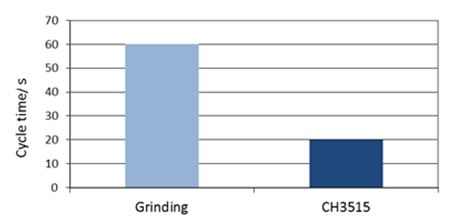
We were contacted by one international customer about improving productivity in a machine cell which was a bottle neck in their production. After analysis of the said cell, one of the improvement possibilities was this facing operation with heavy interruptions. It was identified as an H35 operation and the new CH3515 was the obvious choice. The goal was to achieve 100 parts tool life to have the same change cycle as other tools. It was easily achieved and the success was total. Cycle time was reduced with 40 s per part, which results in 11 000 hours of saved machining time. Annually!
Workpiece
Component: Gear
Material: 20MnCr5, SMG-H3
Hardness: 60-62 HRc
Surface: Pre-machined
Conditions
Operation:
Facing of gear teeth, heavy interruptions
Insert
CNGA120412S-02020-L1-B
Cutting speed: 180 m/min
Feed rate: 0.06 mm/rev
Depth of cut: 0.10 mm
Cutting length: 12 mm/part
Time in cut: 20s
Result
Tool life
CH3515, 100 parts/edge,
40s saved per produced part compared to grinding.
For more information, please contact your local Seco representative, or our Advanced material (PCBN/PCD/CERAMIC) team.

Workpiece
Component: Gear
Material: 20MnCr5, SMG-H3
Hardness: 60-62 HRc
Surface: Pre-machined
Conditions
Operation:
Facing of gear teeth, heavy interruptions
Insert
CNGA120412S-02020-L1-B
Cutting speed: 180 m/min
Feed rate: 0.06 mm/rev
Depth of cut: 0.10 mm
Cutting length: 12 mm/part
Time in cut: 20s
Result
Tool life
CH3515, 100 parts/edge,
40s saved per produced part compared to grinding.
For more information, please contact your local Seco representative, or our Advanced material (PCBN/PCD/CERAMIC) team.

| Author: Stefan G Larsson Product Specialist SECOMAX PCBN/PCD/CERAMIC SECO TOOLS AB 737 82 Fagersta, Sweden Office +4622340572 Mobile +46761367807 email:stefan.g.larsson@secotools.com |
Face milling of case hardened steel with PCBN
02:55
Turning is the most common operation on case hardened steel components after heat treatment. The material “moves” during the case hardening process, and that is the reason why a finishing process is needed, to generate the required surface and dimensional tolerances. Typical components include gears and shafts etc for the automotive industry.
Still, there are applications also for finish milling of case hardened components. It could be a sealing surface where there are requirements on surface finish, but also on flatness.
Seco has been working with PCBN milling for many years, and have today both the experience and products to reach the customers’ goals. A typical example is a pump body, which has a sealing surface with requirements on both flatness and surface finish:
Currently grinding is used to finish the component, and the machining time per component is 8 minutes. The question is, can this be done with CBN?
The component was clamped in a 3-jaw chuck in the larger end, and supported by a tailstock at the smaller end in a machining center.
An adjustable square shoulder milling cutter, 63 mm in diameter, with four positive full-faced TPGW11 CBN-inserts (3 cutting edges per insert) was selected:
So, what was the machining time when using CBN? For each component, the machining time was reduced from 8 minutes to 36 seconds. This is a large improvement, especially when you are making 1 400 components per day!
For more information, please contact your local Seco representative, or our Advanced material (PCBN/PCD/CERAMIC) team.
Still, there are applications also for finish milling of case hardened components. It could be a sealing surface where there are requirements on surface finish, but also on flatness.
Seco has been working with PCBN milling for many years, and have today both the experience and products to reach the customers’ goals. A typical example is a pump body, which has a sealing surface with requirements on both flatness and surface finish:
Currently grinding is used to finish the component, and the machining time per component is 8 minutes. The question is, can this be done with CBN?
The component was clamped in a 3-jaw chuck in the larger end, and supported by a tailstock at the smaller end in a machining center.
An adjustable square shoulder milling cutter, 63 mm in diameter, with four positive full-faced TPGW11 CBN-inserts (3 cutting edges per insert) was selected:
- Cutter R220.68-0063-TP11C-4, z=4
- Insert TPGW1103PNS-LF, CBN200
- Cutting speed 250 m/min
- Feed rate 0.07 mm/tooth (350 mm/min)
- Depth of cut 0.1 mm
So, what was the machining time when using CBN? For each component, the machining time was reduced from 8 minutes to 36 seconds. This is a large improvement, especially when you are making 1 400 components per day!
For more information, please contact your local Seco representative, or our Advanced material (PCBN/PCD/CERAMIC) team.
![]() | Author: Henrik Sandqvist Product Specialist SECOMAX PCBN/PCD/CERAMIC SECO TOOLS Shanghai CO., Ltd. Building 4, No 797, Puxing Road, Pujiang Town, Minhang District, Shanghai 201114, China Office: +86 21 6091 2832 Mobile: +86 185 1520 6942 e-mail: henrik.sandqvist@secotools.com |
Secomax™ CH2540
07:18
High performance PCBN Grades for hard part turning
CH2540 was launced in SECO NEWS 2016-1 and is a completely new grade for H25, interrupted cuts, but also for mixed operations with both interrupted and continuous cuts.CH2540 is developed to replace CBN160C and to be a part of the new grade chain and has bimodal grain size distribution, where fine grained cBN (1 µm) with 15 µm grains added to the structure. This adds both wear resistance and toughness to the substrate which leads to a larger working window.
There are more advantages
The new CH2540 is available in solid format. This format increase number of cutting edges. Comparing with CBN160C has number of cutting edges been increased with 100%.While it is clear to see the economic and insert integrity advantages of solid PCBN, other advantages include reduced inventory and ease of handling of one multi-edged solid insert compared with several single or multi-tipped inserts required to achieve the same amount of work.
For more information, please contact your local Seco representative, or our Advanced material (PCBN/PCD/CERAMIC) team.
Author:Per Ola Jönander Product Specialist SECOMAX PCBN/PCD/CERAMIC SECO TOOLS AB 737 82 Fagersta, Sweden Office +4622340818 Mobile +46703163555 email:perola.jonander@secotools.com |
Selecting the right grade
00:00
Selecting the right grade for the specific application is crucial for the success of a PCBN-test. The selection should be based on the application, but it is also important to look at the existing grade, cutting data and tool wear to be able to make the right choice.
In a continuous application, turning the face and inner diameter of a gear, a typical H05 application, a hard and wear resistant grade like CH0550 should be the right choice, but testing was not successful.

The competition was using a tougher grade suitable for more interrupted turning. Tool wear was chipping of the insert. Looking at the surface of the component, it was obvious that there were small vibrations present.
In this case it was not possible to reduce the vibrations (by changing machine tool, clamping etc), so CBN060K was selected, which is tougher than CH0550, and more able to resist the vibrations, and the result was 25% longer tool life than the competitor.
Two conclusions can be drawn from this:
In a continuous application, turning the face and inner diameter of a gear, a typical H05 application, a hard and wear resistant grade like CH0550 should be the right choice, but testing was not successful.
The competition was using a tougher grade suitable for more interrupted turning. Tool wear was chipping of the insert. Looking at the surface of the component, it was obvious that there were small vibrations present.
In this case it was not possible to reduce the vibrations (by changing machine tool, clamping etc), so CBN060K was selected, which is tougher than CH0550, and more able to resist the vibrations, and the result was 25% longer tool life than the competitor.
Two conclusions can be drawn from this:
- When selecting the grade, look at the application, and look at what the competitor is using. In this case, the competitor had selected the right grade.
- CBN060K has been available for a while, but it is part of the HPT-chain, and still a very good grade, and it has its given position in the wear resistance versus toughness (ISO application area) chart, fully capable of beating any competitor in the H15 area. In a continuous application, turning the face and inner diameter of a gear, a typical H05 application, a hard and wear resistant grade like CH0550 should be the right choice, but testing was not successful.
![]() | Author: Henrik Sandqvist Product Specialist SECOMAX PCBN/PCD/CERAMIC SECO TOOLS Shanghai CO., Ltd. Building 4, No 797, Puxing Road, Pujiang Town, Minhang District, Shanghai 201114, China Office: +86 21 5426 5849 Mobile: +86 185 1520 6942 e-mail: henrik.sandqvist@secotools.com |
CH0550 continues to beat the competition
00:02
The new HPT-grades continue to show good results. When machining of a cylindrical part on a clutch cover, CH0550 improved tool life by 30% compared to the competitor.
The surface criterion was Rz < 2 mm, and a wiper insert was selected, CNGA120408S-01525-L1-WZ-B, CH0550. An additional test was done with a larger nose radius, and that improved tool life with another 10%.
The competitor could also select a larger nose radius and maybe get more tool life, but he had not done that. Instead we strengthened our relationship with the customer by being the practical experts and offering him the best solution.
For more information, please contact your local Seco representative, or our Advanced material (PCBN/PCD/CERAMIC) team.
The surface criterion was Rz < 2 mm, and a wiper insert was selected, CNGA120408S-01525-L1-WZ-B, CH0550. An additional test was done with a larger nose radius, and that improved tool life with another 10%.
The competitor could also select a larger nose radius and maybe get more tool life, but he had not done that. Instead we strengthened our relationship with the customer by being the practical experts and offering him the best solution.
For more information, please contact your local Seco representative, or our Advanced material (PCBN/PCD/CERAMIC) team.
![]() | Author: Henrik Sandqvist Product Specialist SECOMAX PCBN/PCD/CERAMIC SECO TOOLS Shanghai CO., Ltd. Building 4, No 797, Puxing Road, Pujiang Town, Minhang District, Shanghai 201114, China Office: +86 21 5426 5849 Mobile: +86 185 1520 6942 e-mail: henrik.sandqvist@secotools.com |
Secomax™ New PCBN grade chain
01:37
High performance PCBN Grades for hard part finish turning
Use the wear resistance of the new H05 grade or select some of the tougher alternatives perhaps in combination with a wiper, SECO now have a lot of PCBN options available for any hard turning application. CH0550, CBN060K and CH2540 are available as solid and brazed, solid inserts are normally the most cost effective solution.
Make sure that You find the optimal solution for Your hard turning application.
For more information, please contact your local Seco representative, or our Advanced material (PCBN/PCD/CERAMIC) team.
![]() | Product Manager: Anders Wickman Product Manager SECOMAX PCBN/PCD/CERAMIC SECO TOOLS AB 737 82 Fagersta, Sweden Office +4622340254 Mobile +46703431200 e-mail:anders.wickman@secotools.com |
Secomax™ CH3515
07:52
High performance PCBN Grades for hard part turning
CH3515 was launched in SECO NEWS 2016-1 and is a completely new grade for H35, heavy interrupted cuts.If there is a turning operation with really heavy interruptions, for example OD turning of splines the new CH3515 is the correct choice.
Especially if the interruption is not chamfered the application must be seen as H35.
For more information, please contact your local Seco representative, or our Advanced material (PCBN/PCD/CERAMIC) team.
Author:Per Ola Jönander Product Specialist SECOMAX PCBN/PCD/CERAMIC SECO TOOLS AB 737 82 Fagersta, Sweden Office +4622340818 Mobile +46703163555 email:perola.jonander@secotools.com |
Now in stock - CH2540
22:51
Secomax™ CH2540
03:15
High performance PCBN Grades for hard part turning
CH2540 was launched in SECO NEWS 2016-1 and is a completely new grade for H25, interrupted cuts, but also for mixed operations with both interrupted and continuous cuts.The new CH2540 has bimodal grain size distribution, where fine grained cBN (1 µm) with 15 µm grains added to the structure. One advantage of this type of structure is the crack deflection that the coarser grains cause.
By causing cracks to deflect, it takes longer time for the cracks to propagate from edge to edge resulting in less chipping. In a fine grain structure, the cracks moves around the fine grains, while the coarser grains in the new substrate structure cause the cracks to deflect around the coarser grains. This has the biggest effect in interrupted cuts.
For more information, please contact your local Seco representative, or our Advanced material (PCBN/PCD/CERAMIC) team.
Author:Per Ola Jönander Product Specialist SECOMAX PCBN/PCD/CERAMIC SECO TOOLS AB 737 82 Fagersta, Sweden Office +4622340818 Mobile +46703163555 email:perola.jonander@secotools.com |
Prenumerera på:
Inlägg (Atom)